|
Édouard-Léon Scott de Martinville´s Phonautograph
by Jean-Paul Agnard
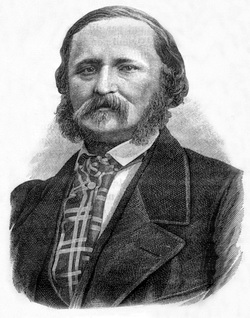
Édouard-Léon Scott de Martinville
|
|
The French inventor Édouard-Léon Scott de Martinville
was born in Paris on April 18, 1817.
A typographer by trade, Scott learned stenography and
became deeply interested in the possibility of recording
speech mechanically. This research led him to invent
the phonautograph, a machine capable of recording
sound vibrations visually.
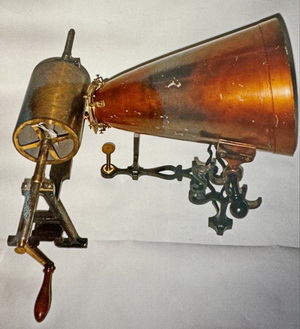
The phonautograph consists of a funnel into which one
speaks, positioned in front of a rotating drum covered
with paper blackened by smoke. At
the end of the horn
is a diaphragm that
vibrates in response
to sound. Attached
to the center of this
diaphragm is a wild
boar’s bristle, which
traces the vibrations
onto the smoked
paper. The recorded
traces are fixed by
immersing the paper
in water mixed with
egg white.
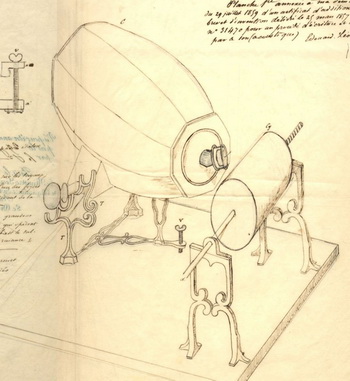
Scott patented the phonautograph on March 25,
1857—exactly 20 years before Edison’s phonograph—
under the name “speech writing by itself.”
My own third significant encounter with the phonautograph occurred in 1989 at the Musée de la Civilisation during the exhibition “From Cylinders (Edison’s) to
Laser.” For this exhibition, I loaned several artifacts
from my own institution, Le Musée Edison du Phonographe.
Scott's original 1857 patent drawing
|
|
That museum was closed in 2017 following a stroke
that left the right side of my body paralyzed. For the
1989 exhibition, the museum borrowed a phonautograph from Utrecht in Holland, as at that time no
phonautograph was known to exist in Quebec.
In September 1994, I wrote to Utrecht to ask for
phonautograms, as my goal was to make them speak
by one method or another. My first real contact with
the phonautograph dated back to the early 1980s,
when Allen Koenigsberg, a collector in New York and
owner of one of only four known examples at the time,
sent me a copy of Scott’s 1857 patent and its 1859
addendum. He asked me to translate these documents
into English, particularly the sections describing the
installation of the diaphragm and stylus, which I did.
The Utrecht museum replied that they regretted they
had no phonautograms. In November 1995, I wrote
again to the curator, pointing out that
their Phonographic Bulletin of April 1977 mentioned
phonautograms in its references. I received no reply. In
July 1997, using the Internet, I sent an email containing the text of my unanswered letter.
The curator replied that he had since changed positions within the university, explaining why the letter had
probably been lost. Once again, the answer was: no
phonautograms.
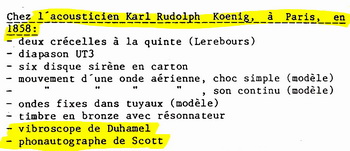
Catalogue record, Musée de la Civilisation, Quebec City
|
|
That same summer of 1997, while visiting the reserves
of the Musée de la Civilisation with Mme Toupin, I
made an unexpected discovery: a “Duhamel vibroscope,” corresponding to the rear section and drum of
a phonautograph. A few minutes later, we also located
the metallic horn, shaped as a paraboloid of revolution,
though still lacking the recording head. By consulting
the list of scientific instruments purchased in Paris in
1858 by Abbé Hamel for Laval University, we were able
to identify the
origin of this
instrument.
I had originally gone to the
reserves
searching for
a curious
hand-driven
Berliner
gramophone
that I had
seen in the
1970s at
the Petit Séminaire in Quebec, and again in the early 1980s at the
seminary’s museum.
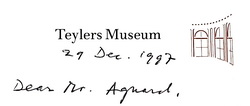
Correspondence with Teylers Museum, Haarlem, Holland
|
|
In September 1997, I contacted the Utrecht curator
once more, asking if he might lend me the recording
head so I could make a copy. He refused, but promised
to send sketches. He also informed me that the Teylers
Museum in Haarlem, Holland, possessed a phonautograph.
I immediately wrote to request a loan. In October, they
declined but promised to provide information.
On September 26, I wrote to the Musée de la Civilisation to explain my project of making phonautograms
audible. To do this, I needed access to a complete
phonautograph, which I had been unable to locate
elsewhere despite years of effort. I emphasized that
this would be a world premiere and could not go unnoticed.
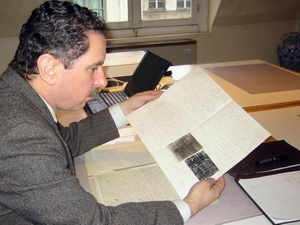
David Giovannoni
|
|
In April 1998, I again wrote to Mme Toupin requesting
a loan of their phonautograph so I could make a complete copy. I received no response.
In November 2000, Mme Toupin and I returned to the
reserves to continue our search for the missing recording head. Our plan was simple: I began from the location where I had found the vibroscope, and she started
from where the horn had been discovered. As we
opened boxes and
drawers and gradually closed the distance between us,
she finally found
the recording head.
That same month, I submitted a new request—this time
for a long-term loan of the phonautograph for my museum in Sainte-Anne-de-Beaupré. This request was
accepted in December, and in January 2001 the
phonautograph arrived in Sainte-Anne. After seven
years of continuous effort, I was finally able to produce
phonautograms, having been unable to locate any original examples.
Original phonautograph
|
|
Between 2001 and 2007, I produced several phonautograms. During this period, I contacted a university
professor in the United States—the same individual
David Giovannoni later contacted in 2008 to make the
famous 1860 phonautogram “Au clair de la
lune” audible, now accessible online through Wikipedia.
Unfortunately, because I was unable to properly fix the
smoked paper and because the professor refused to
work with photocopies, I had to abandon the project—
though I was, quite
literally, only a wild
boar’s hair away
from success.
In 2008, David Giovannoni traveled to
Paris with a high-
precision scanner
to digitize original
phonautograms. That same year, I
began building my
first phonautograph.
Unable to reproduce
the version with the
metal paraboloid horn, I
instead chose to replicate the model shown
in Scott’s patent, featuring a wooden ellipsoidal horn. In April, I experienced what I call
my “chemin de Damas”—a sudden understanding of
how lateral recording on paper was possible even
though the diaphragm vibrated perpendicularly to it. I
was driving back from Wayne, New Jersey, still reflecting on the problem, when the solution became clear:
the diaphragm is not parallel to the axis of the drum,
but set at a slight angle.
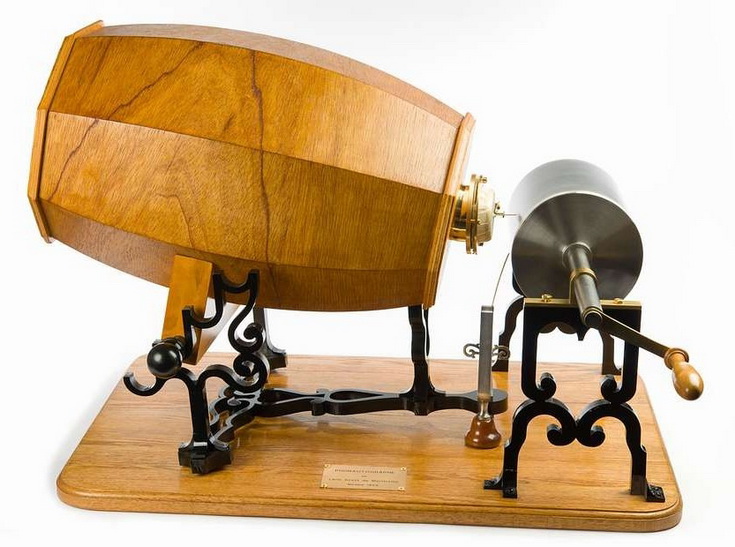
The timing was ideal. I delivered my first machine to
Mr. Eric von Grimmenstein, president of the Dictaphone Museum in Indianapolis, Indiana. In October
2014, I delivered my second machine to David Giovannoni.
|
|
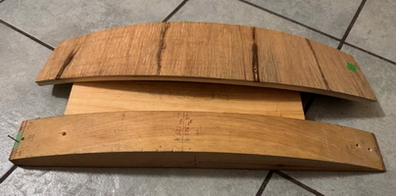
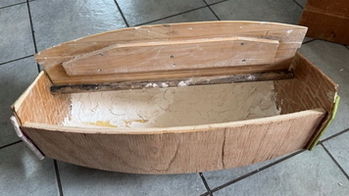
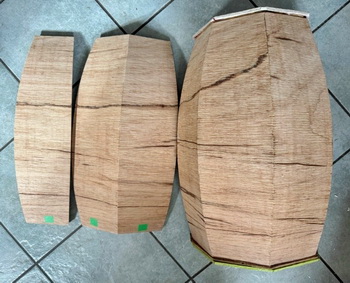
Construction of the octagonal horn
|
|
In early 2016, I began work on a third machine
for the Phono Museum in Paris, to commemorate the
200th anniversary of Léon Scott de Martinville’s birth
on April 25, 1817.
On that occasion, Scott’s grandson, Laurent, was present, and I had the opportunity to speak with him. He
told me that a phonautograph had once been kept in
his family’s holiday home but had been stolen. He
could not say which type it was. It was almost certainly
a model with a metal horn, as no original wooden-horn
phonautograph like the ones I build has ever been
found. However, it may also have been an experimental version previously undocumented.
The machine itself is large, mounted on a wooden base
measuring 22 by 31.5 inches. To fabricate the octagonal-profile horn, the first step is to create eight curved
“petals.” These are made from special bendable mahogany planks, each consisting of two layers glued together with contact cement on a custom mold. Once
removed, they permanently retain their shape.
The eight petals are then arranged in order to preserve
the orientation of their surfaces. Each petal is cut so
they can be joined two by two, with their edges cut at
an angle of 67.5 degrees, and then assembled four by
four.
At this stage, the horn exists in two halves. Before joining them, plaster of Paris is applied to form an ellipsoid
of revolution. To achieve this, I built a special rotating
device that allows the plaster to be shaped while still
wet. I use a prepared spackling material that appears
pink when wet and turns white when dry.
All metal parts were already available, as I had manufactured them in 2008 in anticipation of building four
possible machines. The components supporting the
horn and the drum were copied directly from the original parts of the Quebec phonautograph and laser-cut
from a metal plate one centimeter thick.
The phonautograph reminds us that the recording of
sound began not with playback, but with the desire to
make the voice visible and permanent. My own work
with this instrument reflects that same curiosity and
perseverance. Through reconstruction and experimentation, the phonautograph continues to speak—not by
sound alone, but through the traces it leaves
behind.
Replica of Scott's Phonautograph built in 2014 by Jean-Paul Agnard
|
|
|