|
An Interview with the Inventor of the Gramophone
Canadian Music and Trades Journal, September 1918
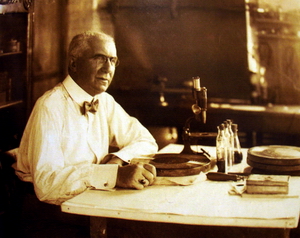
Mr. Emile Berliner, of Washington, D.C., inventor and pantentee of the gramophone, and president of the Berliner Gramophone Co. Ltd., Montreal, when on a visit to the latter city
recently accorded the Journal a very interesting interview. Mr. Berliner was visited in the laboratory of the firm which he founded and the active direction of which is in the
hands of his son, Mr. H.S. Berliner, vice-president of the firm.
To visit this laboratory to which the Journal was admitted, is a privilege accorded to few, and its secrets are as rigorously guarded as were, according to history, the mysteries
of the sanctum sanctorum of Solomon's Temple. The laboratory is on the third floor of the building and its equipment lacks nothing that it is possible to construct or purchase to
the advantage of research work in improving recording processes or the material entering the physical make-up of the record. The visitor to the laboratory sees a series of bottles
of various coloured and colourless liquids that suggest chemistry. There are Bunsen burners, retorts, electric ovens, microscopes and an equipment of fine tools that suggest a
modern engraving plant, a watchmaker's equipment and still more unusual contrivances that mostly suggest mystery.
Mr. Berliner's mission to Canada on this occasion was to collaborate with his son in experimental work having in view further refinement in recording and improvement in materials,
so that the heretofore normal wastage of matrices in record manufacture should be still further reduced. That they were successful it was unnecessary to inquire. The satisfaction of
achievement showed from the eminent inventor's countenance. But, as he modestly suggested, he had the advantage of so many years of experimental work that he knew from previous results
where it would be unnecessary to explore, and much time was saved. On the other hand, a new phase or development carried him back to former completed or incompleted experiments that he
could at once take up and carry to the conclusion required by the demands of present development.
The Journal wanted to know what attracted Mr. Berliner into the field of sound reproduction in the first place. He patiently explained that having been engaged in the telephone
business it was natural that he should become interested in so kindred a science as that of sound reproduction.
"Then what gave you the idea of establishing a business in Canada, particularly at a period when this country was so little known or regarded in the United States?" questioned
the inquisitive Journal representative.
"It was a matter of protecting patents," explained Mr. Berliner. "I thought it wise even then to be protected in this country, and the subsequent manufacture of records was
actually to protect these patents rather than the definite purpose of establishing an industry here and," he added, with a twinkle in his eye, "you never can tell what is going to become of a baby."
The famous "dog on it" was first trade-marked in Canada - and this is news to many readers of the Journal; then in the United States. The picture, as such, had already been copyrighted
in England, where in the office of the Gramophone Co. Ltd., the original still hangs. It is of interest that this dog was first offered to another company in London, England, and
when first submitted to the general manager of the London Gramophone Company the picture was of a cylinder machine. On his suggestion this was changed to a gramophone and the picture
was printed and distributed as an interesting adjunct to gramophone propaganda. When a copy reached Mr. Berliner, he immediately saw its value as a trademark, and its success as such
all over the world proved Mr. Berliner's good judgment.
Thirty years ago, or to be exact, on May 16, 1888, Mr. Berliner in an address to the Franklin Institute of Philadelphia, made the following predictions: -
"A standard reproducing apparatus, simple in construction and easily manipulated, will at a moderate selling price, be placed on the market.
"Those having one may then buy an assortment of Phonautograms, to be increased occasionally, comprising recitations, songs, chorus and instrumental solos
or orchestral pieces of every variety.
"Prominent singers, speakers or performers may derive an income from royalties on the sale of their phonautograms and valuable plates may be printed and
registered to protect against unauthorized publication.
"Collections of phonautograms may become very valuable, and whole evenings will be spent at home going through a long list of interesting performances.
"Languages can be taught by having a good elocutionist speak classical recitations and sell copies of his voice to students. In this department alone, and that of
teaching elocution generally, an immense field is to be filled by the gramophone.
"Addresses - congratulatory, political or otherwise - can be delivered by proxy so loudly that the audience will be almost as if conscious of the speaker's presence.
"A singer unable to appear at a concert may send her voice and be represented as per programme, and conventions will listen to distant sympathizers, be they thousands of miles away."
At that time there was intense interest in the discovery that it was possible to reproduce the human voice, which discovery was the outcome of the development of the
science of transmitting the human voice through the medium of what is now the telephone. Although the discovery that led to the establishment of the talking machine industries
dates back to 1877, it was not until the year 1895 that the industry, then a feeble, ill-nourished infant, with few who had faith in its ever coming to healthy childhood, to
say nothing of maturity, can be said to have been founded, and it is doubtful if even the scientists and inventors present in Mr. Berliner's audience of that May evening thirty
years ago thought his invention would be other than a scientific wonder, or perhaps a toy.
But his predictions have been realized, and more. Mr. Berliner had and still retains that rare combination of inventive genius and business acumen. This could be deducted from
his predictions quoted above, as well as from the fact that he anticipated the development of the talking machine industry in other countries, when he secured his patents and trade-mark
copyrights and later protected them by manufacturing.
The Journal's numerous questions anent the discovery and development of sound production caused Mr. Berliner in his turn to ask a question.
"What," he said, is the most wonderful thing about sound reproduction?"
"That the human voice could be recorded at all," answered the Journal.
"No, not only that," he corrected, "but that all the tones of all the instruments in an entire orchestra can run off from a single finely pointed needle."
Even to the scientist, and to the inventor, the marvel of it remains.
In his laboratory Mr. Berliner works quickly, and with enthusiasm. He can work for days on an idea with apparently no prospective success without the slightest
impatience, but when a result is achieved his pleasure is of that boyish delight that retains for him perpetual youth. Unlike the average inventor, he knows when to
discard an experiment that could lead to no result.
He motored up from Washington to Montreal and though Mrs. Berliner, who came with him, took the train westward, he proposed to motor back, visiting several points on the way.
He thoroughly enjoyed his trip, his visit to Montreal, his experiments and meeting "the boys" of the plant, who have brought the tiny infant of eighteen years ago to the state
of healthy activity it today enjoys.
The Journal man thinking that Toronto was the only place to have established the business, Mr. Berliner was asked why he chose Montreal. The latter city was then, as now,
Canada's telephone headquarters, and personal friendship with officials of the Bell Telephone Co. led him to communicate with them regarding facilities for pressing records and
which were found in Montreal.
In this connection it is an interesting contrast that the day's output of records at the commencement could be carried by one man on his shoulder. The contrast is not only the
thousands of records now produced daily, but that one small dealer in a village will now sell more records in a day than the daily factory output of 1900, and yet record business
has barely commenced.
So mysterious is the sound of human voices coming from a cabinet that it would not be surprising if one could smell the singer's breath, just as the dog has been parodied as
whiffing "his master's vice". Here is an incident in which the listener also scented the singer's voice. An Auxetophone was once presented to Mr. Berliner by one of his boys.
This Auxetophone was designed to enlarge the volume of the gramophone tone. An electric motor and series of bellows were used. In his home in Washington, Mr. Berliner installed the
Auxetophone in the reception hall. The motor and air pump for forcing air through the valve of the Auxetophone he had placed on the other side of a partition, which put them in the
pantry adjoining the kitchen. A visiting friend was being shown the new wonder, and when asked whom he would like to hear sing, he quite naturally asked for Caruso. He listened
most intently, and the more he listened the more mystified he became. When the song was finished he exclaimed, "That's Caruso, without a doubt but - my God, I can smell the onions
on that dago's breath!" So he could smell onions, but they were not on Caruso's breath as he thought. In the kitchen the cook was frying onions and the pump drawing in its supply of
air failed to discriminate between onion-scented and otherwise, hence the mystification of the guest.
To the layman that sound could be reproduced at all, and that so delicate and marvellous an accomplishment could ever be possible scientifically and commercially, is always uncanny,
but to those in the business the problem of problems is materials for the manufacture of records. It was so from the commencement and Mr. Berliner in an address to the Franklin Institute
in 1913, tells that the first successful results of the duplicating process on which he had worked for several years was a record pressed in celluloid by J.W. Hyatt, well known as
one of the inventors of celluloid.
This duplicate is still in existence in the National Museum in Washington, being the first sound record duplicated in hard material which was made by pressing a reverse of the original
record into hard material, while the latter was softened by heat and chilling while still under pressure. This pressure is the basis of the present industry of making millions of records
yearly. There is also a record etched on plate glass deposited in the National Museum at Washington.
"Did it ever occur to you," asked Mr. Berliner, "that records are in reality seals of the human voice? This substance they are made of is a modified sealing wax, both containing shellac
as a basic substance. Few people have a conception of the untiring efforts which have been made year after year, and still continue, in order to obtain a composition which will answer
all the requirements necessary for resisting the wear of the needle or prevent the latter from being ground blunt too fast. If the material is too hard and gritty it will wear the point
of the needle so that before the end of the record is reached the reproduction becomes weak or blurred. If the material is too soft the record groove will quickly wear rough and the record
reproduction become scratchy. Shellac is much adulterated and the mineral and fibrous substances which are added require careful selection, and this whole department is in the hands of
experts who do nothing else all the year around but test the substances and the mixing processes which are employed for producing record material."
Mr. Berliner was well known in the telephone field before he attacked the talking machine problem. He invented the loose contact telephone transmitter in 1877, and no other transmitter
has ever been used since. He added the use of the induction coil to the telephone in the same year, without which practical long distance telephoning is impossible. He also perfected the
early Blake type of loose contact transmitters, and the first 20,000 transmitters ever placed in the hands of the public were personally tested by him while Chief Instrument Inspector of
the Bell Telephone Company. This was in 1879.
In his public addresses and private conversation Mr. Berliner is always most generous in giving credit to contemporary inventors in the field of sound reproduction. He has contributed
valuable information to the scientific world and in his inventions has given humanity entertainment, education and instruction to an extent that no individual can realize. Unlike most inventors,
too, he has made his work pay.
Financially he is as great a success as he is in the scientific world. Apart from his interest in the Canadian business he has large interests in the Victor Talking Machine Company and the
Gramophone Co., Ltd. He has also been active in the aeroplane industry and in torpedo invention.
From Canadian Music and Trades Journal, Vol. 19 #4, pages 84-86, September 1918.
Courtesy Arthur Zimmerman
|