|
A History of 16-RPM Records, Part Two
Audio Books
by Mike Dicecco

|
|
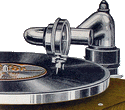
An early 7" 16 RPM Audio Book record.
(Author’s collection)
|
|
|
This article is the second that arises from a CAPS presentation in November, 2009 about
16 2/3 RPM records and their main uses.
As kids, most of us can remember having a four-speed phonograph, with the slowest speed being 16 RPM. It might have been good for
slowing down 45s and 33s to produce bizarre results, but few of us ever saw the records that were meant for that speed. As we updated
our turntables in the 1970s, we found that most manufacturers had now dropped this obscure speed, but this did not seem to matter. In addition,
it also appears that record collectors have largely ignored the format too. Indeed, precious little information is available about 16 RPMs!
Mark Quail and I put together some research into this elusive speed and gave a presentation at the CAPS November 2009 meeting. Mark’s findings
on the Chrysler Hiway Hi-Fi were published in the March 2010 issue of APN. This article will look at some of the technical aspects, and "talking books".
Future articles in this series will examine the Seeburg Background Music system, and some other "odd" speeds: 24 RPM and 8 RPM phonograph records.
Most record collectors are aware of the following timelines of manufacture:
| •
|
78 RPM: 1890s to 1959
|
| •
|
45 RPM: 1949 to 1989 to present (limited)
|
| •
|
33 RPM: 1948 to 1990 to present (limited, with a recent resurgence)
|
16 RPM appears to have originated in the 1930s, flourished in the 1950s, declined in the 1960s, and disappeared by the early 1970s as
long-playing portable tape (especially cassettes) became more popular.
In this article I will attempt to shed some light on this most unusual and neglected record speed. Finding information on the origins of
this 16 RPM format has been extremely difficult: Unlike the beginnings of 78s, 45s, and 33s, we’ve not been able to determine a definitive
creation and release date, or even what company or individual was behind the format!
The earliest known reference to 16 RPM releases appears to be in an early 1930s RCA catalogue. The listing is for John Bossart’s "Record for
Weight Talking Machines, 21-Dec-1931, 11 1/2" diameter". (1) After this, there is a gap until the early 1950s.
The book, From Tin Foil to Stereo by Oliver Read and Walter Welch, was also consulted as it is one of the most complete and thorough
documentations of recorded sound, and is often viewed as a reference "bible". To my amazement, there was not one reference to 16 RPM records!
It is as though they never existed.
Most of the information from this article has come from various internet sources, product manuals, samples from my personal record collections,
and tidbits of info picked up from other collectors.

|
|
A comparison of an early (left) vs. later Audio Book pressing. The cardboard adaptor
was supplied with the early pressings, so that they would conveniently fit onto a
conventional turntable spindle. Later pressings utilized a "45 RPM"-type pressing, but
were still cut at 16.
(Author’s collection)
|
|
|
OVERVIEW OF 16 RPMs
The speed per se, was used by several record manufacturers, who all attempted to exploit the format in their own way. We can divide the use
into four main categories:
| 1)
|
a personalized car music system, used by Chrysler, named Hi-Way Hi-Fi
|
| 2)
|
talking books and speeches
|
| 3)
|
background music systems for restaurants and businesses
|
| 4)
|
limited music formats
|
There appears to have been little standardization in terms of size: the records (that we know about) came in 6 7/8" (Hi-Way Hi-Fi), 7"
(various centre-hole sizes, such as Talking Books), 9" (Seeburg Background Music Systems, with 2" centre-holes) and 10" and 12" (looking
like conventional LPs). The 16 RPM format also appears to never have been used by the broadcast industry (likely due to the low fidelity,
and the fact that long-playing records of the 16" variety were available to them. Radio stations were also some of the earliest users of
magnetic tape.). The greatest use of 16 RPM by the general public appears to have been from around 1950 to 1958 (Talking Books), which period
also corresponds with the "War of the Speeds" ( 78 v/s 33 & 45 RPM). The public was likely thought to be more accepting of an additional speed,
during this period of multiple formats. This very lack of standardization, however, may have partially led to the demise of the format. The
format was not limited to North America. Examples have been found from Germany, France, England, and Russia.
SPECIFICATIONS
In general, we can make several comments about 16 RPMs. The exact speed was actually 16 2/3 RPM, which is exactly half of 33 1/3 RPM. In order to
increase the recording time even further, an extremely small cut was used, referred to as "Ultra-Microgroove".
Standard LPs were cut with a 1 mil stylus, where as 16 RPMs were cut with either a 0.5 or 0.7 mil tip. The Chrysler Hi-Way Hi-Fi’s were cut
with 0.25 mil. (in contrast, 78 RPMs are typically 3 mil groove size). In light of this ultra-microgroove, both Seeburg Background Music and
Hi-Way Hi-Fi warned of the "irreparable damage" that would result if their records were played using a conventional 1 mil LP stylus. Talking Books,
however, designed their records to be played by microgroove equipment, so that more people would have the home equipment for playing them.
Frequency response was typically in the range of 300-3000hz.(equivalent to a telephone) Some mid-1960s 16 RPM records were actually cut in stereo,
and boasted a response up to 10,000hz., although this was probably very optimistic.
A ten-inch 16 RPM record would have an average playing time of 45 minutes per side. Quite a considerable feat, considering that the same size
78 RPM disc was only 3 minutes in duration (but of much higher fidelity).

|
|
Holy Bible: The Complete New Testament. This 24-disc "ultra-microgroove" 16 RPM set was
first released in 1953 and played for 23.5 hours. It must have been a big seller, as many
copies can be found today. No narrator’s name is listed. An abridged version of the Old
Testament was also available.
(Author’s collection)
|
|
|
THE AUDIO BOOK COMPANY
In 1935, the Royal National Institute for the Blind recorded (on 16 RPM shellac discs) a reading of Agatha Christie’s The Murder of Roger Ackroyd.
This was the first "Talking Book", and was released for the U.K. market. Many more titles followed in the years to come. (2)
However, the most prolific user of the speed, for the talking books genre, was The Audio Book Company located in St Joseph, Michigan, and
appears to have started business around 1952. Their material spanned everything from poems, to classic stories, to modern works.
One 1954 jacket proudly listed the following titles available:
| •
|
The Audio Book of Famous Poems
|
| •
|
The Autobiography of Benjamin Franklin
|
| •
|
The Great Tales and Poems of Edgar Allan Poe
|
| •
|
The Best of Mark Twain
|
| •
|
The Trial of Socrates
|
| •
|
Strange Case of Dr Jekyll and Mr. Hyde
|
| •
|
The Basic Writings of Ralph Waldo Emerson
|
| •
|
The Complete Sonnets of William Shakespeare
|
| •
|
The Complete New Testament (The famous "Talking Bible" containing the entire King James Version on 26
Audio Book records. Total playing time, approximately 24 hours)
|
| •
|
The Old Testament (9 complete Books including Genesis, Psalms, Proverbs, Isaiah, and others)
|
| •
|
Alice in Wonderland
|
| •
|
The Wizard of Oz
|
| •
|
Story-time Favourites (26 famous stories for children)
|
| •
|
The Merry Adventures of Robin Hood
|
| •
|
Stories from the New Testament for Young People
|
| •
|
Stories from the Old Testament for Young People
|
| •
|
A Child’s Garden of Verses
|
| •
|
Gulliver’s Travels
|
| •
|
Rip Van Winkle and the Legend of Sleepy Hollow
|
| •
|
King of the Golden River and The Great Stone Face
|

|
|
An assortment of some popular releases. The centre bottom record was in the short-lived "Music Series".
(Author’s collection)
|
|
|
A later "Music Series" featured classical works, but this appeared to be short-lived (based on the relative few that have survived).
The fidelity of the one copy I have is surprisingly good.
"New Titles will be added to this list as rapidly as they can be produced—the great 'Classics' of literature that have withstood the test of
time and many 'popular' books of all kinds for both adults and children. We believe you will enjoy Audio Books as much as we enjoy producing
them and we cordially invite your comments and suggestions as to which books should have top priority on our production schedule".
The earliest Audio Book Company records were unusual 7" ultra-microgroove records, with a 3" centre-hole and no paper label! The titles were etched
into the dead wax near the centre. One example in my collection came with a very rare cardboard disc adaptor that is used to insert into the 3" centre
hole of each record so that it may be played on a conventional turntable (see photo).
Mention is also made of a most interesting device:
"These revolutionary new 16 RPM Talking Book phonograph records may be played on any 16 RPM record player. They may also be played on any 33 1/3 RPM
phonograph by using the Audio Book speed reducing Adapter supplied for that purpose. Simply place the Adapter on the phonograph turntable and play as
any other phonograph records".
Certainly this was an attempt by Audio Book to have their product reach a broader market. Unfortunately, to date, I have been unable to locate one
of these speed-reducing devices.
Later versions issued by Talking Book appear as conventional 45 RPM records, but recorded at 16 (see photo of early v/s later pressings). By the
mid 1950s, the "45" was becoming more popular, so it made sense to reduce costs by utilizing a conventional press for these records (but still
recording them with their unique groove size at the 16 RPM speed). I have also seen some late 1950s and early 1960s Talking Books, released in 10"
and 12" formats, with a jacket, looking like a conventional LP (but again at 16 RPM). Release of new material appears to have ceased by the mid 1960s.
Prices were comparable to those of an LP, but varied according to the number of records in the set. The attached ad from Billboard, May 30, 1960,
shows a set of four 7" discs costing $4.95, and an eight-disc set retailing for $8.95. A nice album was always included to hold the records.
The narrators of the material were often unknown or little-known at the time, likely to keep costs down. Most of the titles I’ve seen have had male announcers.
These Talking Book records sometimes show up on e-Bay. Prices will range from a couple of dollars to about $25+ for the more popular authors (Ben
Franklin, Edgar Allen Poe, etc). As in their day, there appears to be a limited market.
The Audio Book Company appears to be the main label that made use of the 16 RPM format for home consumption. They gambled with a new medium to
bring their "Talking Books"” to the forefront. Considering the sudden jump in recording time, from a 78 RPM disc, this truly was a revolutionary
step at the time. This market was later serviced by the audio cassette, which provided much more portability.

|
|
A South African pressing of songs by Chubby Checker.
(Author’s collection)
|
|
|
A LIMITED MUSIC + PREACHING FORMAT
Since almost everything eventually shows up on e-Bay, it’s no surprise that some music 16 RPMs have surfaced. See the accompanying photo for a
South African pressing boasting 80 minutes, or 32 songs on one record (Chubby Checker).
I can instantly think of some downfalls with this set-up:
| 1)
|
Since song royalties must be paid on each pressing, a record with 32 songs would involve considerable costs just to get the publishers’ clearing rights.
|
| 2)
|
It would make more economic sense to sell a second or third "volume" at 33 1/3 RPM, so that more profit could be reaped.
|
| 3)
|
Having sixteen songs per side on a 12" record would make it very difficult to locate individual tracks.
|
| 4)
|
Last but not least, is the poorer sound quality with limited frequency response and increased wow and flutter at 16 RPM.
|
A forum of record collectors documented another use of these extra-long-playing records. This is a recent entry: "My dad had several 12" 16 RPM
records. They were all mono 'dinner music' albums. They were supposed to play throughout an entire meal without one having to turn them
over. That was their purpose! Said so right on the jacket! I still have one of them, 'Hawaiian Style Dinner Music'. Instrumental, no vocals, and
not very ‘HiFi’." (3)
A quick search of "You Tube" resulted in videos of turntables playing Herb Alpert, Jim Reeves, and a French-made Sydney Bechet record at
16 RPM. Vox Records also had a short lived series of classical 12" records at the speed.
The televangelist preacher Jimmy Swaggart released a series of eleven discs of sermons in the 12" 16 RPM format, with an LP-type jacket.
It was on the "Jim" label (i.e. his own) and appear to have sold well. The discs were also given out at revival meetings and, although they
would have played for almost an hour per side, we have to wonder how many of his followers were able to actually play these records. They often
show up on e-Bay, but do not command more than $10.
I hope that you have enjoyed this look at 16 RPM Talking Books, and related information. If you have additional information to share with us,
we welcome your input via the "Letters" section of APN. We’ll continue this format discussion next time, with a look at the Seeburg Background
Music system, and the United States government talking book program for the blind.
Footnotes:
Mike Dicecco is CAPS Vice President.
|