|
Some Notes on Orthophonic Era Soundboxes
by Thomas Rhodes
After the advent of "Victor Day" on
Monday, November 2, 1925, the accepted
thinking about the nature and format of the
garden variety talking machine was forever
changed. No longer was the public, which was
already embracing the home radio receiver
in ever increasing numbers, content with the
essentially Edwardian upright Victrola. They
were not necessarily deserting the phonograph
field but were decidedly restive over the long
reign of a mechanical record player that had
been bestowed with only incremental and
largely cosmetic betterments over the course
of nearly twenty years! It was not that the
sound of early radios was luring them away; in
fact, many early radio horns had more limited
output than even a minor league phonograph.
The appeal of apparently endless and costfree
entertainment, with no spring-winding
chores, needles to misplace or fragile disks
to break, proved of immense appeal; strong
enough to challenge the talking machines’
long hold on domestic entertainment.
No. If the talking machine were to survive, two
paths had to be taken. One, to "civilize the
beast" by making radio simply a part of a
"combination" instrument. Two, to better the
sound of the talking machine so that its appeal
would be strengthened and its traditional
patronage regained. The Victor Orthophonic
line admirably accomplished both these goals
and literally gave Victor a new lease on life.
One of the features of the new Orthophonic
instruments was its soundbox, like nothing
previously offered by Victor or any other firm.
In this short piece we will therefore examine
this soundbox and its effect on design thinking
among competing manufacturers, in the general
quest to update and improve talking machine
technology in the "Phonic Era".
Beginning Remarks
A talking machine is nothing more,
from an engineering standpoint, than
a mechanical loud-speaking telephone
transmitting a recorded message. Given the
underlying and fundamental similarities of these
two devices, Western Electric engineers were
able, using circuit analogy design precepts, to
reconfigure the standard upright phonograph
into a form that made the fullest and most
efficient use of its given size and features.
When the outside-horn machines of the earliest
gramophone era began to be replaced by insidehorn
cabinet instruments, we had, in the words
of Compton Mackenzie of Gramophone fame,
"acoustics subordinated to cabinet work". In
essence, for nearly two decades Victor and its
competitors sold what has been dismissively
called "phono-furniture".
Then, with the design
work on an "improved mechanical phonograph"
begun at Western Electric in 1922 by a small
team led by Henry C. Harrison and
including Paul B. Flanders, Edward
L. Norton and Theodore Osmer,
with substantial input from
loudspeaker pioneer
Albert L Thuras, the
cabinet-enclosed
talking machine
was not rejected but
instead raised to a lofty level of applied acoustic
engineering. Aside from the greatly enlarged
horn, calculated to precise logarithmic formulas,
the outstanding feature of the new Orthophonic
line was its vastly bettered soundbox.
Brief Engineering Basics
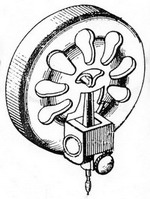
A soundbox is a mechanical transducer, which
converts the potential energy engraved into
the wavy spiral groove of the disk into kinetic
energy, by the agency of the record spinning
under its needle-arm assembly. This movement
of the needle-arm or stylus bar, in essence a
pivoted armature, is transferred to the diaphragm
which, fastened securely to the armature, must
necessarily itself move in concert with the
imparted groove modulations. Now, the area
behind the diaphragm, enclosed by the outer
wall of the backplate, causes the soundbox to act
like a compression-type loud speaker, meaning
that the armature/diaphragm assembly works
into this enclosed and deliberately constricted
space, in the fashion of an air pump, forcing
wave motion from the backplate through
the throat and into the tone arm, where it is
channelled into the horn assembly. The horn
(and the tone arm in talking machines with a
tapered arm, like the Victor and Victrola) acts
as a coupling between the soundbox and the
air within the room. It does this by being a
gradually expanding chamber that transforms
the incoming sound waves of small size and
high velocity into outgoing larger waves of
slower velocity. At this point the sound waves
leave the horn mouth and radiate into the
surrounding air. A horn therefore, no matter
what its size or shape, depends upon being
driven by the soundbox, itself a mechanical
analog to a loud speaker motor. If the soundbox
is poorly designed or otherwise inefficient as a
transducing or converting agent, the output of its
associated horn will likewise be poor.
In the mechanical period (sometimes called
the "acoustic era"), the customary soundbox
employed a diaphragm made of mica
(micaschist), a natural geologic substance easily
split or cloven into thin plates suitable for the
purpose. This occurred before the development
of reliable plastics, so the early gramophone
engineers can hardly be faulted for the choice.
However, from the standpoint of sound
transmission, the mica-equipped soundbox has
several drawbacks. One, a given mica disk
itself has only so much mechanical compliance
or yield factor. Too thin a disk will not hold
up under repeated use and will necessarily be
prone to damage and distortion. Two, the need to
securely clamp the mica disk both for positional
stability and to prevent air leaks around the
gaskets, further limits its compliance. Three, the
clamping pressure used tended to either raise or
lower the natural vibrational period or periods of
the mica disk, adding unpleasant resonances to
the frequency band of interest. Four, the mica
diaphragm is driven at one point only, where
it was attached to the needle-arm. This tends
to produce a diaphragm action that bends the
mica disk mostly at its center, with movement
falling off as it reaches the periphery. Such an
action might be sufficient for reproducing the
customary acoustically recorded disk, with its
rather limited frequency and dynamic range,
but is unsuitable for transmitting input from an
electrically cut record.
An Early High Compliance SoundBox
Joseph P. Maxfield, an MIT graduate hired,
along with colleague H. C. Harrison, by Dr.
Frank Baldwin Jewett into Western Electric
in 1914, had witnessed for patent on August
23, 1917, an improved soundbox designed
with much higher compliance than the garden
variety mica- equipped models. Its diaphragm,
of differential thickness made (like those
patented by an older Western Electric inventor
Henry C. Egerton for Western Electric loudspeakers)
from molded fabric, was not only
of better yield characteristics, but had less
annoying resonances as well. The diaphragm
of this early Maxfield soundbox, like those
designed by H. C. Egerton, had a thicker center
portion for "plunger" action, and a thinner
outer periphery for long excursion properties.
The salient features of this soundbox, although
embodied in forms different from the later
Harrison-authored diaphragm, no doubt
influenced the latter’s thinking in terms of
performance goals.
The prevailing model customarily employed
by acoustic scientists of this period was that of
a straight pipe or tube driven by a diaphragm
acting as an infinitely smooth piston. This
theoretical tube produced no wave-form
distortion either at the driving end or at the
open end. Sound conducted through this tube
was to be an orderly succession of perfect
planar waves, which obviously existed only in
laboratory studies, not in the rough and tumble
of the commercial talking machine world!
Henry Harrison found, however, that if a body
intermediate between needle-arm attachment
point and diaphragm were introduced, the
diaphragm tended to act with much more
plunger action, like the ideal piston. This
interposed body or structure tended to spread
out the motion from the armature, affording
the desired broader action in the diaphragm,
which in turn caused more air to be displaced
compared to the center-biased mica disk. This
was especially critical in the transmission of
lower frequencies or bass, just like the wide excursion
cone speakers of the upcoming
Electrola and Panatrope models, then also in
development. Thus was born the spider of the
eventual Orthophonic soundbox that in turn
led to the cone intermediate element of the
Brunswick soundbox and the dome structure of
the Columbia VivaTonal models!
Better Diaphragm Materials
It was not enough, however, just to place an
additional structural member before the main
diaphragm. Even with such a structure, whether
spider, cone or dome, the elastic limits of mica
could not have been overcome. What was needed
was a new material, thin enough for compliance
yet reasonably free from unwanted bending and
"billowing". Egerton and Maxfield chose fabric
strengthened with phenolic, a good choice for
low resonance during their gestation period
of 1916-1917. However, there was another
telephone tradition which could lend itself to the
cause. Aluminium diaphragms had been used in
telephone handsets years before, and in the early
1920s, during the Harrison investigations, a
relatively new aluminium alloy called duralumin
(known technically as alloy 17 S-T) made with
4% copper, 0.5% manganese and an equal
measure of magnesium, came into industrial
usage. This alloy proved to have the ideal
properties sought by Harrison, namely strength
combined with flexibility. After the advent of
the Orthophonic line in the fall of 1925, Victor’s
chief rivals, Brunswick and Columbia, followed
suit, discarding without regret their micaequipped
soundboxes in favor of formed light
alloy diaphragms. In our next instalment we will
examine the particular features of each of these
soundboxes, to determine how they bettered
the performance of the new lines of large-horn
mechanical disk instruments.
Concluding Note:
This researcher would like to thank Mr. Keith
Wright for encouraging me to write this brief
soundbox piece and for featuring it in this fine
publication. Most of the data in this article
was adapted from my book-in-preparation, The
Orthophonic Victrola in Word and Picture,
specifically the chapters entitled "Henry
Harrison and His Talking Machine World" and
"Competing Machines" Readers wishing to
learn more about talking machine acoustics are
encouraged, if they have not already done so,
to visit the outstanding Victor-Victrola Page
maintained by my correspondent Paul C. Edie.
Mr. Edie, an acoustic engineer of wide learning
and deep understanding, features an invaluable
chapter entitled "An Introduction To Vibro-
Acoustics" that should be required reading for
any serious talking machine collector!
|