CD
|
|
|
|
Antique
Phonograph
News
Canadian Antique Phonograph Society
|
Mar-Apr 2007
|
|
| Jan-Feb |
Mar-Apr |
May-Jun |
Jul-Aug |
Sep-Oct |
Nov-Dec
|
The Old Town Hall Auction
by Mike Dicecco
|
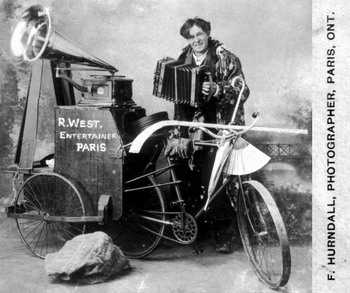
Paris, Ontario has a long association with phonographs. Remember the
photo-postcard from about 1905 of the wonderfully-wacky R. West, Entertainer, which was used on the
cover of a previous CAPS Membership Directory. (Collection of Bill & Betty Pratt)
|
|
|
The small town of Paris, Ontario (north
and west of Hamilton), often plays host
to a most interesting auction, which takes
place about every 6 to 8 weeks. Inside an old
converted church are often 700-plus items, most
of which are from estate clear-outs, and usually
consist of art, lamps, jewellery, furniture, rugs,
china, etc.
I hadn’t been to one of these auctions in about
5 or 6 years. I felt, however, that I could not
ignore the auction of February 17th 2007, due
to the description
that was given in
their pamphlet:
"Super collection
of antique
gramophones &
gramophone parts,
--cylinders—1000’s
of records, --
antique and retro
radios…" I’m sure
that anyone reading
this newsletter
would understand
my excitement!
My cousin Rob
and his wife, Pina,
were kind enough
to do the hour
plus driving from
Toronto on this
cold winter day.
The auction seemed
to attract much
larger crowds than
in the past. Part of
the reason, I’m told,
was due to advertising on the internet. It was
standing room only for us and it seemed like a
long day, as approximately 100 items per hour
were sold under the hammer. If you’ve been
only to a CAPS meeting auction, you’ll find the
pace at this event is extremely quick. Do not
pay attention and you’ll miss the item being
sold (and I’m speaking from experience!)
Listed below is a rough inventory of most of
the phonograph-related pieces. In addition to
the selling price, the lucky buyer can expect
to pay a10% buyer’s premium, 7% Provincial
Tax, and 6% Goods and Services Tax (so a
24% mark up can add considerably to the final
invoice).
• Edison Fireside Model B. Good condition,
with original paint cygnet horn, crane and lid.
Diamond B reproducer: $1200
• 30 or so unusual records, Pathé , Hit of the
Week, Berliner, etc: $260
• Pathé outside-horn disc machine (#4?), with
re-painted horn: $1600
• Victrola VI, good original shape: $170
• Box of 62 two- and four-minute cylinders:
$160
• Edison Gem, Model B, 2-minute with extra
horn. Fair shape, repainted horn: $450
• Outside-horn "Clement Saturn" disc
phonograph, repainted horn: $580
• Columbia BK, 2-min with Lyric reproducer:
$400
• Box of 50 cylinders: $170
• Four odd horns (makes unknown): $170
• Large assortment of unusual needle tins: $300
• Approx 300 Diamond Disc Records (sale
price U/K)
In addition, there were a couple of other Edison
Diamond Disc upright console machines (sorry,
but I didn’t get the models) that sold for a very
reasonable $150 and $200.
Usually there are very few, if any, phonograph-related
items at this auction. However, if you
like other antique items, you may want to check
it out to see what deals are available.
The Old Town Hall Auction is at
13 Burwell St,
Paris, ON
N3L 2C4
519-442-6892
Website: The Old Town Hall Auctions
|
|
Bettini and the Perils of Advertising
by Robert Feinstein
|
Ever hear of a "Bettina" phonograph, as in this June 1899 ad?
|
|
|
"All genuine Micro-
Diaphragms have the name
‘BETTINI’ stamped on
them." Such was the last sentence
of Lieutenant Gianni Bettini’s
April, 1900 cylinder catalogue,
the front cover of which bore
his surname no less than four
times. Indeed, by the turn-of-the-
century, it was engraved or
emblazoned on all of his growing
line of phonographic devices, and
became the unofficial trademark
of those he produced in the
United States.
On June 5, 1900,
Lieutenant Bettini actually did
register it as a French trademark,
even before incorporating his
Paris-based firm, the Societe des
Micro-phonographes Bettini,
the following year. Doing that
was in part a business move to
discourage firms such as Pathe
and Cahit, which began marketing
"spider" reproducers that were
quite similar in design to his own,
but the lieutenant also did so quite
simply because of immense pride
in his moniker and heritage. It
also may have been a reflection
of his rivalry with Thomas A.
Edison, who trademarked his
signature in France on February
23, 1900.
Bettini registered a
second French trademark, this
time for his signature (which had
only the "g" of his first name, written in lower
case, but include his full surname, with the "B"
capitalized), on July 13th of that year.
The inventor’s advertisements also prominently
displayed his name, although searching
for them in vintage magazines can be a
daunting, frustrating task. All too many of
the microfilms and archived bound volumes
available to modern
researchers have
omitted advertising
sections. The earliest
Bettini ad that I
have uncovered
appeared in The
Phonoscope of June,
1897. Other U.S.
periodicals that he
advertised in during
the late 1890’s and
the first three years
of the twentieth
century included:
the Playbill of the
Metropolitan Opera
House, Metropolitan
Magazine, Leslie’s,
Harper’s, American
Housekeeper,
Scribner’s,
Century, American
Monthly Review of
Reviews, Edison
Phonograph Monthly,
The Delineator,
Popular Science,
and McClure’s. In
France, Bettini used
La Nature (Paris
Edition), Femina,
Vie Populaire, Le
Figaro (also the
Paris Edition) and
the rather bawdy Le
Rabelais to advertise
his wares. Of all
these, the only one I found that ever made a
serious typographical error in the lieutenant’s
advertising copy was the above-mentioned
McClure’s, a muckraking journal which
earned a considerable admiration for exposing
corruption and injustices of the era.
|
Bettini Ad in Popular Science, 1899
|
|
|
Although,
with the passage
of time Bettini
could muster
stoic, goodnatured
humor
about the
unintentional
mistakes of
others (for
example, in a
Leslie’s article
of May, 19,
1899 he said:
"One day, four
or five years
ago, an assistant
let fall a box
of cylinders
covered with
new records
and a dozen
or more of my
finest voices
were silenced
in an instant.
They were all
broke up and
so was I"), the
McClure's' typo
must have been
especially grief-provoking.
All was well
with his
McClure's ads
for April and
May, 1899.
Both featured the familiar statuette mounted
on a pedestal, supporting a highly stylized
Edison Opera Phonograph, with a Bettini
reproducer and horn that he repeatedly used in
his broadsides, catalogue covers, and even his
stationery. That entire ensemble, incidentally,
has been rumored to have turned up in New
Zealand, a nation where a number of verified
Bettini artifacts, including cylinders, have been
discovered. But at the top of the June, 1899
advertisement, McClure's misspelled his name
as BETTINA.
The error may well have caused the lieutenant
to reevaluate the design of his advertisements,
for changes ensued. Bettini ads that ran each
month from September through December,
1899 in Popular Science, now had a fragmented
tribute to the phonograph: "A machine with
a soul, able to awake and perpetuate all the
pleasantest and strongest emotions of life, will
revive the past and bring back the absent. The
most truthful teacher and guide for musicians,
singers, elocutionists, speakers, preachers,
students of dramatic art, etc. Carrying
vocal messages to all parts of the world, and
preserving the same for posterity. The most
agreeable companion in solitude, and a great
entertainer for invalids, putting the favorite
songs, instruments and the most favorite
artists at your instant command." Lieutenant
Bettini was so fond of these words that his
aforementioned April, 1900 catalogue included
a very similar sentiment. And an advertisement
he placed in the December, 1899 issue of The
Phonoscope, included the statuette motif on the
left, but on the right, it added an entirely new
feature that he would often employ in the years
that followed: portraits of eight opera stars,
embedded on the lids of overturned Bettini
cylinder boxes.
|
|
|
|