Go to CAPS Home Page

CAPS
History
Constitution
Executive
40th Anniversary
Meetings

Membership
Join CAPS
Directory

Newsletter
2010
2008 2009
2006 2007
2004 2005
2002 2003
2000 2001
1998 1999
1996 1997
1994 1995
1992 1993
Index
Advertising

CD
Tracklist
Booklet
Buy CD

Articles
Canada
Berliner
Victor
RCA
Columbia
Brunswick
Additions
Compo

Reference
Links
Journals

Go to CAPS Home Page

Antique Phonograph News
Canadian Antique Phonograph Society


Nov-Dec 2006

Jan-Feb Mar-Apr May-Jun Jul-Oct Nov-Dec
Canadian Songwriters Hall of Fame Gala
by Mark Caruana and Mike Bryan

(L-R) Bill Pratt, Mark Caruana, Bob Nix, and Michael Bryan pose in front of one of the CAPS displays at the Canadian Songwriters Hall of Fame Gala attended by an audience of 1000+ this past February.

This past January, CAPS executive was contacted by the organizers of the Canadian Songwriters Hall of Fame Gala to see if we could provide them with a display of phonographs for the reception before and after the show on February 5th. There would be over 1,000 "musically interested" guests attending the Gala at Toronto’s Metro Convention Centre and CAPS was being invited to share our phonographs, our hobby, our passion with them. Wow!... what an unprecedented opportunity for public exposure on such a large scale.

Immediately, CAPS President, Bob Nix, went into overdrive to organize a team and make a plan. At first sight, the task seemed quite simple – just collect a few phonographs, plonk them on a table and there’s the display ... but, of course, it wasn’t quite that easy. How much space would we have, what kind of room would it be, which phonographs should we display, do we need posters and promotional material, etc.? The team soon established a clear purpose: "To provide gala guests with an exhibition of antique phonographs, relating specifically to the 'Pioneer Era', of the three eras that will be recognized at this event." The other two eras would be the "Radio Era" and the "Modern Era".

This was certainly a tremendous opportunity to showcase our hobby, so it would be important to be well organized and ready with a consistent message about CAPS. We set about our project with two goals in mind:-

• Create an interest in antique phonographs and recordings

• Raise awareness of CAPS and promote membership

We learned that we would have two tables for our display and they would be set about 20 feet apart near one end of the reception room. Our enthusiasm nearly got the better of us as we developed an ever longer list of machines that we thought would be great to display, but we soon realized that less might be more, and that we should keep it simple. So we settled on one table for cylinder machines and one for disc machines, spanning the golden age of the phonograph, with examples from the familiar name brands of Edison, Victor, Berliner and Columbia.


CSHF Overview of the Cylinder Display
The collections of Domenic DiBernado, Mark Caruana and Mike Bryan were raided for the chosen machines and CAPS is grateful to them for bringing them out. Thanks, too, to Bob Nix and Bill Pratt for bringing some well-chosen records and other support material. The result was a magnificent exhibit of phonographs representing a wide variety of styles, while also including many items of ephemera. The machines displayed were:-

• Berliner Gram-O-Phone Model A Trademark. c1900 Made in Canada
• Berliner Gram-O-Phone Model K c1905 Made in Canada
• Victor VI with brass horn c1910 USA
• Edison Gem Model D, 2 & 4 min. c1910 USA
• Edison Fireside Model B with Cygnet Horn, 4 min c1913 USA
• Edison Home Model A, 2 min. c1902 USA
• Columbia Graphophone Type AQ, c1903 USA
• Columbia Graphophone Type AB, c1903 USA

The week prior to the Gala was unusually dry and warm and boded well for Bob’s long drive from Sarnia to Toronto for the Sunday evening event, planning to call in at Mike’s and Domenic’s to pick up the phonographs. However, all that was to change with the announcement of a perfectly timed winter storm for the weekend. Not wishing to risk being stranded in the snow, Bob set out a day early and stopped over at Mike’s place, ready for the shorter drive to Domenic’s and on to the Gala in Toronto. The weather on Sunday morning could not have been much worse, but with great care and patience, Bob and Mike loaded the van and set out for Domenic’s, where they waded through the rapidly deepening snow, protecting the most prized machines in their arms like babies until they were safely snuggled in their blankets in the van… the phonographs, not Bob and Mike. Twenty minutes later, as we approached the outskirts of Toronto, the snow began to lighten up and by the time we arrived downtown, there was not the slightest trace of snow on the ground or in the air…leaving Bob and Mike expounding tales of hardship to local disbelievers who had no idea what they had been through to get there. Oh well.


CSFH Disc Display
So there we were at the Toronto Convention Centre, in a big empty room, all dressed more smartly than we had ever seen one another before. After pinning on some professionallooking CAPS name badges produced by Bob, the team was ready to start. Soon the two tables were put in place, conveniently close to the bar, and we began to lay out the display. The colourful machines and their eye-catching horns soon caught the attention of the Convention Centre staff, who seemed thrilled to see such unusual items.

Hoping that we might use this opportunity to attract some new members to CAPS, Mark and Mike collaborated in producing a new CAPS flyer/membership form. Copies of the flyer, the CAPS CD "Dance Bands from Canada 1922- 1930" and the "The Berliner Gramophone, an Illustrated History" book, were placed in the few gaps available on the tables and, after some final tweaking and adjusting, the display was ready. It wasn’t long before the first guests began to arrive and that’s when the fun really began. "My mother used to have one of those.. how does it work ... what is that ... where do you find these amazing machines ... can I hear it play ... there should be a museum for these wonderful pieces ..." a barrage of non-stop comments, questions and engaging conversation from a succession of delighted guests. It was a great pleasure to share our knowledge and satisfy the curiosity of so many fascinated people. And then suddenly they were gone, answering their call into to the John Bassett Theatre for the Gala performance.

Mike volunteered to stand on guard with the CAPS display, while the others tagged along into the theatre for the show, courtesy of the event organizers.


Carmen Lombardo Jr,(left) came from Florida to honour his uncle, and talked to Bob Nix of CAPS
The ceremony included the induction of a number of Canadian honorees, including such well-known celebrities such as Anne Murray (Legacy Award), Lucille Dumont (Legacy Award), The Stampeders (Song: Sweet City Woman), Leonard Cohen (Songwriter), Andy Kim (Songwriter: Sugar Sugar), and Gilles Vigneault (Songwriter: Mon Pays), and of course pianist Willie Eckstein, (who was so famous that when Rachmaninoff visited Montreal around 1920, he asked to be taken to the Strand Theatre to hear Eckstein play!)

Also being inducted were several historical figures, such as Carmen Lombardo, who was the true driving force behind The Royal Canadians, a group which was conducted by his well-known brother Guy Lombardo. During his career, Carmen sang, played sax and composed the group’s numerous hits, which have stood the test of time, being used in such films as "Annie Hall" and "Bullets Over Broadway".


Singer Andy Kim Listens to 1900 Record
Another historical Canadian inducted that evening was Herbert Berliner, son of Emile Berliner. Herbert’s contributions included being vice-president and general manager of the Berliner Gram-O-Phone Company of Canada, and eventually founding Canada’s premier record pressing company, Compo.

After the show, the guests streamed out of the theatre for the post-Gala reception, once again surrounding the CAPS display and taking an interest in the phonographs and music. The evening was quite a success for CAPS, as we were given a prominent location for our display and managed to gain a great deal of exposure with many attendees showing interest in our hobby. All agreed that it had been fun sharing a common purpose and working together to put on a great display that clearly left a favourable impression of CAPS and our hobby. Many thanks to CAPS President Bob Nix and members Mike Bryan, Mark Caruana and Bill Pratt, for making the evening a success.

Doing a Guest Appearance at the Edison Museum of Vienna
by Bob Nix


Bob Nix Gives a Demonstration at the Edison Museum
In this newsletter are some interesting facts about the Edison Museum of Vienna, Ontario, located south of Tillsonburg. My wife and I accepted an invitation to be a part of the Edison Living Legacy Exhibit: from Cylinders to Diamond Discs, which will be on display until mid December 2006. You’ll see some of the news releases for the event, as well as photos I took of some of the displays. In a later issue of APN we’ll be publishing an article, The Edisons of Bayham by Carol Judd, Vice-chair person at the museum. It will chronicle the Canadian connection of the Edison family, this information often being forgotten (or ignored) by historians.

Before the I Pod, CD, MP3, before cassettes, 8 Tracks, stereo and radio, there was the phonograph. Its invention in 1877 left the world startled, amazed, and filled with curiosity and delight.

Since Thomas Alva Edison died seventy-five years ago, and the phonograph was his favourite invention, this exhibit seems a fitting way to commemorate his life and legacy. The phonograph was capable of playing ALL types of music at a moments notice. This was truly a marvel in its day. It was the first time that people could take – and transport – music suiting any taste, to accompany them, whether on a boating party or a bicycle picnic, or simply at home. The phonograph caused a revolution in entertainment. Oddly, Edison originally and for some time saw his phonograph as primarily a business machine. The exhibit explores the beginnings of the phonograph, the first machine to reproduce sound. On the second floor is the "Invention Room" showing some of Edison’s more interesting inventions.


Talking Machines at Edison Museum
The Edison Museum displays many artefacts pertaining to the local Edison family and inventor Thomas Edison, who visited here often in his youth. These include furnishings and art, and also a variety of Edison’s many inventions. The phonograph exhibit will be in place until December 20th, 2006. Its public hours are Tuesday, Wednesday & Saturday, 1:00 to 4:30. Admission is $2.00 per adult. Children twelve and under are free.

For more information, phone the Edison Museum of Vienna at 519- 874-4999, or email edisonmuseum@amtelecom. net. Visit this part of Edison Canadian history, that few have discovered.

Early Nod to Nipper
by Betty Minaker Pratt and Bill Pratt

J. & J.Colman Ltd, in business since 1814, was well aware of the enormous dividends to be reaped from investment in advertising their yellow tins of mustard powder. One of their long term promotional items was a series of booklets that was given away free to children every Christmas from the 1880s into the 1950s. "Children treasured these booklets. For many they were the first and only books they ever owned."

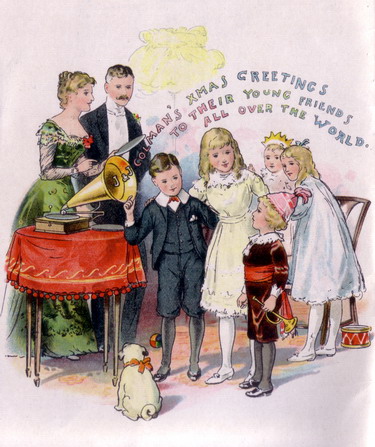
Rhymes and Tunes For Little Folks is a 20-page booklet, 4 1/4 x 5 1/2 inches, with 16 nursery rhymes, musical scores with lyrics, and 12 colour illustrations. The first page inside the front cover shows "J. & J. Colman's Xmas Greetings to Their Young Friends All Over the World".

Loosely adapted from Francis Barraud's painting, it depicts the familiar subject of the little terrier, Nipper, listening intently to the recorded message emanating from a Berliner "Trademark" Gramophone. The talking machine may not be an exact rendering of the Type B Berliner, but the artist is clearly familiar with the model showing a brass horn, side brake, and external spring box mounted on the back, with a crank handle on top. In this rendition Nipper, with two black-tipped ears, is placed prominently in the foreground, but he is not the focus of attention. The boy in the paper party hat with a trumpet is centre stage, in his Little Lord Fauntleroy suit. Mothers had imposed this fashion on boys since 1886 when Frances Hodgson Burnett published her popular children's novel.

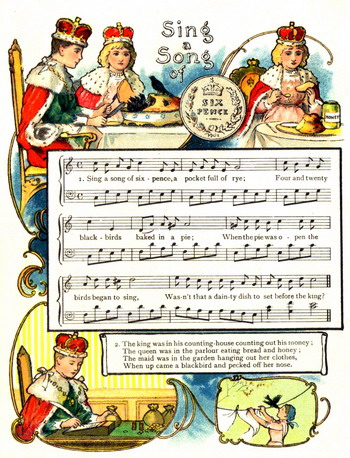
This is an early use of the Nipper theme. Page 3 of the booklet, "Sing a Song of Six Pence", showing the king and queen, confronted with a hopelessly underbaked blackbird pie, conveniently dates the illustration with the depiction of a sixpence coin of 1902. From 1880 to 1939, Colman's issued special pictorial tins every year, including one for Edward VII's coronation in August 1902.

Colman's industrialists were collectors of landscape paintings by various artists in East Anglia throughout the nineteenth century. Their collection is still displayed in the Norwich Castle Museum and Art Gallery. By 1902, they commissioned printers of this booklet to use different illustrators of childrens' books. Perhaps Cecil Aldin or John Hassall were amongst those chosen to do the artwork. Were these artists acquainted with Francis Barraud and his studios in Liverpool and Piccadilly? Barraud often exhibited with other artists at the Royal Academy, London, or The Institute of Painters in Oil Colours.

Barraud completed his famous painting in 1899. On December 5 of that year the first prints of photographs of the painting were available in London. By the end of that month these reproductions were circulated in trade literature, including a Christmas 1899 Gramophone Company advertising card. In January 1900, "His Master's Voice" made its initial appearance on a Gramophone Company record advertising supplement. Also in that year Barraud exhibited a 10 x 12 inch watercolour of his painting at the Royal Institute of Painters and Watercolourists in London where it sold for 15 guineas.

Emile Berliner is thought to have seen the original "His Master's Voice" painting on a visit to England in early 1900. On May 26 he applied to register the picture as a trademark at the U.S. Washington Patent Office, following in July with registration at the Canadian Patent Office. Berliner's required statement during his patent application said he had been using the picture of the dog listening to the sound reproducing machine continuously in his business since May 24, 1900. Its very first appearance on records was in Canada in the Fall of 1900, stamped on the back and in the grooves of 7" Berliners. By March 1901, Nipper started to appear on items such as Eldridge Johnson's Victor needle packets. In October 1901, Johnson used the Dog on his company letterhead and by May 1901, Nipper appeared on most of their goods.

So, the endearing painting of "His Master's Voice", soon to become famous all over the world - some say the most recognizable trademark ever - was an apt and topical subject for the Colman's group of artists and their series of seasonal nursery books for little folks.

Acknowledgements:

Colman's Mustard Shop, Norwich
http://www.colmansmustardshop.com/acatalog/The_Children_s_Story.html

"Little Lord Fauntleroy"
http://en.wikipedia.org/wiki/Little_Lord_Fauntleroy

Archives, Unilever Company, Port Sunlight, England, Nov. 30, 2006.
And http://www.unilever.co.uk/ourbrands/foods/colmans.asp

Norwich Castle Museum & Art Gallery, Norwich Castle Study Centre, Shirehall, Nov. 14, 2006
And http://www.24hourmuseum.org.uk/museum_gfx_en/SE000101.html

Leonard Petts, The Story of 'Nipper' and the 'His Master's Voice' Picture, p.8

Ruth Edge and Leonard Petts, The Collectors Guide To 'His Master's Voice' Nipper Souvenirs, pp. 988 - 991

Allen Koenigsberg, The Patent History of the Phonograph 1877-1912, p. 41

John Rutherford, December 2, 2006, personal communication. In the 1930s John Rutherford went to school with artist John Hassall's son, John Hassall Narbeth. His Father was best known for advertising posters and other ads for Colman's mustard.