|
The Regal Phonograph Company Ltd. of Toronto
Part II
by Jennifer Mueller
|
|
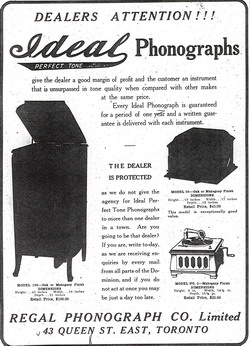
From the Canadian Music Trades Journal, Feb 1917, showing one of the first advertisements
for the new company
|
|
|
Manufacture and Models
It is very difficult to determine exactly how the "Victoria" and "Ideal" phonographs were
manufactured. It is known that Regal finished the cabinets and assembled the machines from parts purchased wholesale.
Initially Stevenson likely did this himself, although it is not clear if he made the cabinets. When the company
expanded in 1917, a factory was set up on Church Street. Regal possibly began to manufacture cabinets in the Church
Street factory, but the date may be as late as 1921 when Ideal Cabinets Ltd., came into existence. Since Regal employed
a "Finisher" from 1917 onwards, some cabinet work did occur.18
Later, the factory relocated to West Toronto Junction, while the offices and retail store remained on Church Street.
The cabinets were constructed from wood and wood veneers which were then hand-polished to a gleaming shine. The
phonograph machines continued to be assembled from purchased parts. Regal’s suppliers included W.H. Banfield & Sons Ltd.
(a Canadian manufacturer of phonograph motors located at 370-386 Pape Avenue, Toronto), and General Phonograph
Corporation (formerly the Otto Heineman Phonograph Supply Co., an American firm with a Canadian office in Toronto)
among others.19
Transfers bearing the "Ideal Perfect Tone" mark were then applied to the machines.
Regal produced at least eighteen different models in its seven year history. It manufactured both tabletop and floor
models, all of which were handoperated and were capable of playing all makes of records without the use of special
attachments. One of the early "Ideal" phonographs, Model 2, was a "mahogany finished cabinet, equipped
with a double spring, fibre geared motor, universal tone arm and jewel point."20
This tabletop phonograph retailed for $25.00 in 1917.
|
|
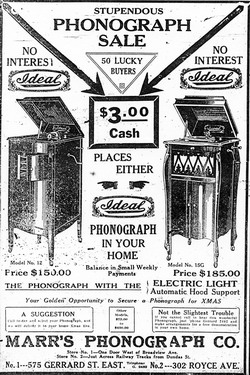
A Stupendous Sale. Toronto Evening Telegram Dec 20, 1920
|
|
|
Oddly enough, more information is available on the "Premier" phonograph, the successor to the "Ideal".
The cabinet phonographs are identical in appearance, and since E.A. Stevenson was responsible for the manufacture of both
machines, it is safe to assume that many of the specifications would be similar too. The "Premier", like the
"Ideal", was equipped with a tone modulator and a convertible tone arm, which permitted the playing of any
make of record. The motor had a heavy cast frame, two detachable barrels made of spring steel, bronze meshing gears,
was graduated for seven different speeds and was capable of playing three records on one winding. The phonograph had
a twelve-inch turntable. Models were available with either a fretwork grille or with doors. Weight was approximately
75 lbs.21
Dimensions and finish varied with the model.
Appendix A consists of a table which provides a description of the known "Victoria" and "Ideal" models
and their prices. Model information comes primarily from company advertisements. Based on their illustrations, there
doesn’t appear to be much difference between some of the models, although newspapers were notorious for using stock images
rather than true illustrations.
Distribution
The Regal Phonograph Company was a very small player in the highly competitive Canadian market, and Stevenson’s first
attempts to distribute the "Victoria" model were a dismal failure. His reasons for trying to sell the "Victoria"
through agents and false newspaper ads rather than through retail stores remains a mystery. Perhaps he was still employed
at Nordheimer’s, or perhaps he had trouble finding willing retailers. Regardless, his fraud conviction must have tarnished
his reputation. It is no wonder that Stevenson stopped manufacturing "Victoria" models and introduced the "Ideal"
line of phonographs. It is possible that because of his conviction, Stevenson also had difficultly finding retailers for his new
line. Instead he attempted to attract "canvassing piano dealers and salesmen who have no salesrooms, or who do not wish
to carry a stock of phonographs."22
|
|
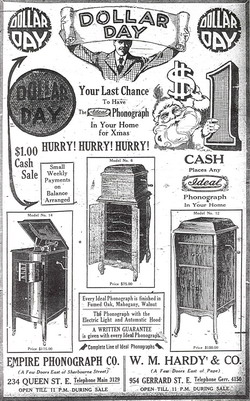
Toronto Evening Telegram, Dec 23,1920 pg 21. The same models were distributed
by Victoria Music at same price. Note error in models - The #14 is a really a #12 & vice versa.
|
|
|
This new strategy had an impact on the distribution of the "Ideal" phonograph, dispersing sales to smaller
centres and rural communities. In 1916 one of Regal’s first sales agents, Maurice Cohen, a salesmen from Toronto,
held the "exclusive agency for the sale of Ideal Perfect Tone Phonographs,"23
in Northern Ontario, including North Bay, Cochrane, Sault Ste. Marie and Port Arthur (now Thunder Bay). The relationship with Cohen
was probably short-lived since Cohen attempted to trademark the "Ideal Perfect Tone" name without Stevenson’s approval.
According to Stevenson’s lawyers, Cohen was "only one of many agents who have purchased phonographs on like terms," and thus had
no rights to the name.24
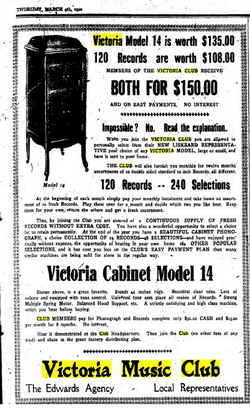
Regal tried to maintain its sales in northern Ontario by distributing its machines through the Victoria Music Club in 1920. Although there
is no absolute proof, evidence indicates that Regal manufactured machines for the Club which labelled them "Victoria" so as not
to "conflict with the manufacturer’s regular trade."25
Club members were offered a choice of Model No. 6, 12 or 14 and a monthly selection of records for reasonable payments. This sales technique
was a popular method of selling phonographs and records in the early 1920s. Several major retailers launched clubs with special sales plans.
Unfortunately, not much is known about the Victoria Music Club, other than one distributor in New Liskeard, Ontario. Only two months of
advertising later, and the Victoria Music Club disappeared.
|
|
One of only two known Victoria Music Club advertisements. The Club promoted and sold
Regal phonographs under the "Victoria" model name in Northern Ontario.
(New Liskeard Speaker, March 4, 1920, p.3)
|
|
|
After this episode, Regal’s marketing strategy changed and became more focussed upon Toronto. The company hired W. Norman Martin
as its salesman. Martin, who also became secretary-treasurer for Ideal Cabinets, greatly expanded the number of retailers.
26
Although it is impossible to determine Regal’s complete network of dealers, there were at least seventeen retailers who sold Ideal
Phonographs in Toronto in 1921.27
The majority were stationers, jewellers or tobacco shops who sold phonographs as a sideline, but there were several phonograph retailers
among the group. Regal also continued to operate its retail store on Church Street. A cursory review of a few other newspapers and
directories beyond Toronto did not reveal any additional retailers.
Regal’s advertising, mostly in the Toronto Evening Telegram, remained limited to sales events and the peak Christmas period. In its entire
existence, Regal placed only eight ads in the industry magazine, The Canadian Music Trades Journal, and six of
those appeared in 1917, when the company underwent a major expansion. It did, however, advertise in the annual Canada
Gazetteer and Business Directory, a national directory used by businesses across the country. The ad targeted
potential dealers, large and small, and included an illustration of Regal’s latest model and indicated the price range
of models available. This single advertisement would have given Ideal Phonographs greater visibility to retailers
across Canada than any ad in the newspaper or even from the trade journal. But if the bankruptcy ads can be believed
(perhaps with a grain of salt), "Ideal" phonographs did find a market. According to the liquidators, "hundreds
and thousands of these superior grade phonographs are in use from coast to coast. Reliability and steadfastness of
manufacturing policy gave a phonograph to the Canadian trade worthy of its high merit, as the peer of all phonographs."
28
Conclusion
My old phonograph cabinet is embellished with three gold maple leaves and the word "Victoria" scrolled under the
lid. Part of Regal’s patented lighting system also remains. On the back is the small brass plaque identifying it as an
"Ideal" phonograph, manufactured by the Regal Phonograph Company. It looks very much like a Model 14 "Ideal"
phonograph and it may be a relic of the short-lived Victoria Music Club or old "Victoria" model stock. I guess
I will never really know. Sadly, I will also never know if it had a perfect tone, or who danced to its music. But I do
know from where it came, and I am pleased to have this small piece of Canadian music history in my home.
Appendix A: Regal Phonograph Company phonograph models
Model No.
|
Year Advertised
|
Description
|
Price
|
| Victoria |
1915-1916 |
|
$80.00 |
|
Ideal Models
|
| Model No. 2 |
1917 |
Tabletop phonograph, mahogany finish only, equipped with
double-spring, fibre geared motor, universal tone arm and jewel
point. 8" h x 14 ½" w x 15 ½" d |
$25.00 |
| Model 6 * |
1920 |
Tabletop phonograph with heavy motor (plays 3 records on 1
winding), 12" turntable, universal tone arm. Available in oak,
walnut or mahogany. Matching cabinet also available. |
$75.00 |
| Model 9 |
1921 |
Tabletop phonograph. Matching floor cabinet also available. |
$75.00 |
| Model 10 |
1916 |
Tabletop phonograph, open case, oak finish, 9" h x 16" w x 16" d |
$17.50 |
| Model 12* |
1920, 1921, 1922 |
Floor cabinet model, 43 ½ high, multiple spring motor, universal
tone arm, electric light, automatic hood support. Available in
fumed oak, mahogany, walnut. |
$125.00 |
| Model 14* |
1919, 1920 |
Floor cabinet model, 45" high, multiple spring motor, improved
tone control. Available in mahogany, fumed oak and walnut. 1920
version included automatic hood support, universal tone arm and
electric light. |
$140.00
(1920 price $175.00) |
| Model 15 |
1919 |
Floor cabinet model, available in walnut, mahogany and fumed
oak with a fretwork grille. |
$150.00 |
| Model 15G |
1916 |
Floor cabinet model, fretwork grille. |
$185.00 |
| Model 16 |
circa 1919-1920 |
Floor cabinet model, straight legs, top cabinet included shelves
for records. Available in mahogany, fumed oak, walnut |
$165.00 |
| Model 50 |
1916, 1917 |
Tabletop phonograph, available in oak or mahogany finish
13" h x 17" w x 19" d |
$45.00 |
| Model 60 |
1915-1916 |
Tabletop phonograph, available in mahogany, golden or fumed
oak finish |
$60.00 |
| Model 75 |
1917 |
Floor cabinet model, mahogany finish
42" h x 19" w x 21" d |
$75.00 |
| Model 85 |
1917 |
fumed oak |
|
| Model 100 |
1916, 1917 |
Floor cabinet model, available in oak or mahogany 43" h x 18" w
x 21" d |
$100.00 |
| Model 1918 |
1917, 1918 |
Floor cabinet model |
$90.00 |
| Model B |
1922 |
Floor cabinet model, decorative grille, cabinet in fumed oak,
mahogany, golden oak |
Reg. $155.00
Sale $87.50 |
| Style 8 |
1922 |
Reg. Ideal Co. style, floor cabinet model |
Reg. $270.00
Liquidation price $69.00 |
| Style B |
1922 |
Chippendale style floor cabinet model, (very similar to Model 15) |
Reg. $225.00
Liquidation price $47.00 |
| Style H |
1922 |
Colonial Style floor cabinet model on casters |
Reg. $200.00
Liquidation price $37.00 |
|
1922 |
Queen Ann style |
Reg. $270
Liquidation price $57.00 |
|
1922 |
Parlor Grand style |
Reg. $295.00
Liquidation price $78.00 |
|
1922 |
De Luxe style |
Reg. $325.00
Liquidation price $98.00 |
|
Endnotes
- City of Toronto Archives, City of Toronto Assessment Rolls, Ward 3, Division 5, 1916-1918.
- Advertisement, Hughes Sales Co., Toronto Star, 7 July 1922, p.20.
- "The New 'Ideal'," Canadian Music Trades Journal, Volume XVII, No.8, January 1917, p. 65.
- Advertisement, United Factories Outlet Co., The Globe, 13 April 1923, p.5.
- "The 'Ideal' Phonograph," Canadian Music Trades Journal, Volume XVII, No. 6, November 1916, p. 72. See also Regal Phonograph Co. advertisement, p. 42.
- Library and Archives Canada (LAC), RG 105, Vol. 68, docket 88771. Letter from E.E.W. Curry, O’Connor & Wallace, Barristers & Solicitors to the Honourable Minister of Agriculture, 5 October 1916.
- LAC, RG 105, Vol. 68, docket 88771. Trademark application for Ideal Perfect Tone Phonograph, October 1916.
- Victoria Music Club advertisement, New Liskeard Speaker, 19 February 1920, p.3.
- The Toronto City Directory, 1921 (Toronto: Might Directories Ltd., 1921). See also the Toronto City Directory for 1922.
- Regal Phonograph Company advertisement, Toronto Evening Telegram, 4 November 1921, p. 26.
- Advertisement, Hughes Sales Co., Toronto Star, 26 May, 1922, p.10.
|