|
The Regal Phonograph Company Ltd. of Toronto
Part I
by Jennifer Mueller

|
|
Jennifer's Regal Phonograph
|
|
|
Introduction
In the summer of 2004, I purchased an old phonograph cabinet at a garage sale. The phonograph components were long gone,
and the cabinet looked as if it had spent years in a barn. But I like old furniture and this piece had nice lines, a
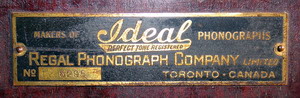
mahogany finish and a fair price. So I brought it home. Upon closer inspection, I noticed a brass plaque on the back of
the cabinet. It read: "Regal Phonograph Company Limited Toronto Canada, Maker of Ideal Perfect Tone Registered
Phonographs, No. 6295". My curiosity got the better of me, and I started to research the history of the Regal
Phonograph Company, Limited. This article is the result of what I learned.
History of the Regal Phonograph Co. Ltd.
The Regal Phonograph Company was established in 1915 by E.A. Stevenson. Edwin Alexander Stevenson (1883-1947) was born
in Ontario but began his career in Rhode Island with the sales department of the Columbia Phonograph Company in 1906.
Stevenson subsequently moved to Columbia’s Toronto office. In 1915 he became a salesman with Nordheimer Piano and Music
Company in the talking machine department of their Toronto store, located at 220 Yonge Street.1
Around the same time, Stevenson started the Regal Phonograph Co., working out of a phonograph repair shop at 43 Queen Street East. He
produced a phonograph called the "Victoria", a name chosen in obvious imitation of the "Victrola".
There is very little information available about the "Victoria", other than the fact that Stevenson assembled
the machines from parts purchased wholesale.2
It was described at the time as "a very good machine, a
machine of good tone, ... and would be an ornament in any home."3
Unfortunately, Stevenson’s attempts to
market the "Victoria" landed him in court and resulted in a conviction for fraud. Instead of finding retailers
to sell the machine, Stevenson secured several women to act as agents. The agents bought the phonographs from Stevenson
for $80.00. They were instructed to sell the phonographs from their homes as if they were selling a single used item.
Stevenson then placed advertisements in newspapers which offered a used Victrola-style talking machine, original price
$250.00, for the bargain price of $90.00. This price allowed the agents a "profit" of $10.00. Since the machine
was a new "Victoria" phonograph the advertisements were fraudulent. The agents continued the deception by
showing the buyer a forged receipt for the $250.00 and sometimes substituted a different machine than the one originally
viewed. Stevenson was charged in March 1916 and was convicted in April. He paid $500 in bail (approximately $8,000 today)
and was given a suspended sentence.4
Not surprisingly, Stevenson ceased to manufacture the "Victoria".
In March of 1916, Regal introduced the "Ideal Perfect Tone" line of phonographs. An American firm, United
Talking Machine Co., of Newark, New Jersey, introduced its phonograph model called "Ideal" roughly one year
later. There is no evidence of any connection between the two companies or phonographs.5
Initially Regal
offered three models, two tabletop and one floor. Prices ranged from $17.50 to $100.00. This was the beginning of a
major expansion of the company. Early in 1917, Regal obtained a provincial charter and became a limited liability
company. Stevenson remained the company President and General Manager. The new company sought larger premises and in
May 1917 leased 145 Church Street, a three-storey building which provided space for the company offices, a showroom
and factory.
|
|
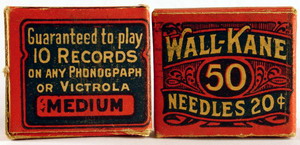
Wall-Kane needle boxes. Courtesy of Bill Pratt. Note the spelling of the word PHONOGRAPH
|
|
|
Regal’s expansion went beyond the manufacture of phonographs. As permitted in its new charter, the company could
purchase, exchange, sell and deal in all the component parts of phonographs and records.6 And so they did.
The company became a Canadian distributor for Wall-Kane needles in the summer of 1917. These needles were guaranteed to
play 10 records before the needle required changing - a bonus during the shortages of the First World War. Regal
continued to distribute Wall-Kane needles into 1919 and probably beyond. At the same time, they became one of five
Canadian distributors for Par-OKet records. These small (7 ½ inch diameter) double disc, hill-and-dale cut records
retailed at 40¢ each, and were part of the miniature record fad of the late teens.7 Regal’s association
with the Paroquette Record Manufacturing Company of New York, however, was short-lived. The record manufacturer
declared bankruptcy in May 1918, leaving Regal without a record label to distribute.
Between June 1917 and 1920, the Regal Phonograph Company, Ltd., went quietly about its business. It ceased to advertise
in the Canadian Music Trades Journal, the industry trade publication, and only rarely advertised in newspapers. But in
1919, it appears that the company relocated its factory to 53-55 Maria Street in the West Toronto Junction district.
In 1920, there was another flurry of activity. In March of that year, the Regal Phonograph Company obtained a patent
for a lighting system for talking machines.8 Essentially, the patent described a battery-operated lamp that turned on
when the hood of the phonograph was raised, and turned off when closed, much like a modern refrigerator. In April,
Regal once again became a record distributor, this time for Gennett records. The Starr Company had begun pressing
records under the Gennett label in 1918, and distributed them via the Starr Company of Canada. By 1920, Starr had
expanded its network to include smaller wholesalers like Regal. Regal advertised that they held "every record
in stock, and will fill your order the day it is received."9
Regal took another major step in August 1920 when it was issued supplementary letters patent. This patent increased
the company’s capital from $40,000 to $100,000.10 A securities company marketed the shares for Regal and
provided a brief view of the firm:
This company has been in operation for over three years and shown steady and consistent growth. For the first six
months of 1920 the sales show an increase of 17% over the first six months of 1919....The management of the company
is in excellent hands, and the distribution of their product is remarkable. It is only for the purpose of taking care
of additional business that this stock is being offered.11
|
|
Close up of the Regal Name Plate
|
|
|
After 1920 the company faded from sight. There was reference to E.A. Stevenson’s marriage and extended honeymoon to
New York and Europe in the Canadian Music Trades Journal, May 1921, but Regal’s corporate activities went unnoticed.
In 1921, Regal created a sister company, Ideal Cabinets, Ltd., which manufactured cabinets. Almost nothing else is known
about Ideal Cabinets, in part because it was so short lived. When the Regal Phonograph Company, Ltd., declared bankruptcy
on 31 March 1922, Ideal Cabinets also went under. Ironically, just a few days before the end, Regal placed an ad in the
Toronto Star, announcing a major sale of Ideal Phonographs. But it was too little, too late. The company owed its
creditors over $25,000 and owned assets of just under $12,000.12 Regal’s stock was purchased by Hughes Sales
Co., and sold to the public.
The bankruptcy wasn’t quite straightforward, however. Stevenson was charged with theft and fraud under the Bankruptcy
Act. He had allegedly falsified the books, had stolen $4,000 and had kept property which belonged to the company.
Stevenson pleaded not guilty, but according to the Toronto Globe he "was quoted as admitting the charges, but
justifying his actions by reason of the small salary he received."13 The judge dismissed the charges
due to lack of evidence.14 Stevenson walked away from the fiasco and formed a new company, the Premier
Phonograph Company, which commenced business in 1923. It became a retail store, Premier Radio Co., at 505 Yonge Street,
Toronto, in the 1930s and continued under Stevenson’s guidance until his death in December 1947.15
The history of the Regal Phonograph Company fits into a larger pattern in the Canadian talking machine industry.
Numerous small companies opened in Canada during the boom years of the First World War. As phonograph patents belonging
to the three major companies - Berliner, Edison and Columbia - expired, the number of small companies offering new
machines proliferated. By 1919 there were 20 manufacturers of phonographs, cabinets and records operating in Canada,
producing 38,598 phonographs that year. A year later production grew to over 44,000 phonographs. Demand for the machines
was high, but it couldn’t last. By 1924 the number dropped significantly to 17,707 phonographs manufactured in
Canada.16 The market was oversold and there was a general business slow-down. The post war economic
situation and the value of the Canadian dollar resulted in numerous small companies going out of business.17
Regal was one of them.
Endnotes
- "E.A. Stevenson," The Globe, 1 January 1948, p.5. See also, "Trade News," Canadian Music Trades Journal, Volume 16, No.1, June 1915, p.61.
- "Talking Machine Business Aired in Toronto Police Court," Canadian Music Trades Journal, Volume XVI, No.10, March 1916, p.43.
- "Judge Condemns Fraudulent Advertising," Canadian Music Trades Journal, Volume XVI, No.11, April 1916, p.64.
- Archives of Ontario, RG 22-5871, File 26/1916, R vs. Stevenson. See also "Judge Condemns Fraudulent Advertising," p. 64.
- R.J. Wakeman, "263 Machines and Their Makers: 1916-1923," http://www.gracyk.com/makers.shtml
- Ontario, Companies and Personal Property Security Branch, Ministry of Consumer and Business Services, File TC 3867, Regal Phonograph Company Ltd.
- "Par-O-Ket Record Distributors for Canada," Canadian Music Trades Journal, Volume XVIII, No.1, June 1917, p. 44 and
advertisement, p.46. A brief overview of Par-O-Ket records can be found in Allen Sutton, "Little Wonder, Emerson and the Miniature Record Fad (1914-1919)," Mainspring Press, 1996 revised 2004.
See http://www.mainspringpress.com/little.html
- Canadian Intellectual Property Office, Patent number CA 198107, Lighting System for Talking Machines, 9 March 1920.
- Advertisement, Regal Phonograph Co. Limited, Toronto Globe, 10 April 1920, p. 17.
- Ontario, File TC 3867, Regal Phonograph Company Ltd.
- Advertisement, Unlisted Securities Corporation Limited, Toronto Globe, 19 August 1920, p.12.
- "Regal Phonograph Co. Estate," Canadian Music Trades Journal, Vol. 22, no. 12, May 1922.
- "Former General Manager Faces Charge of Fraud," The Globe, 29 May 1923, p.15.
- "Charges are dismissed against E.A. Stevenson," Toronto Star, 30 May 1923, p.9.
- "E.A. Stevenson," The Globe, 1 January 1948, p.5.
- Canada. Dominion Bureau of Statistics, Preliminary Report of the Musical Instrument Industry in Canada, (Ottawa: 1921), p. 1 and report for 1920 (Ottawa: 1922), p. 1. Report
on the Musical Instrument Industry in Canada, 1924 (Ottawa: 1926), p.2.
- Edward B. Moogk, Roll Back the Years: History of Canadian Recorded Sound and its Legacy (Ottawa: National Library of Canada, 1975), p. 61 and 91. A similar situation existed
in the United States. See also R.J. Wakeman.
|