CD
|
|
|
|
Antique
Phonograph
News
Canadian Antique Phonograph Society
|
Jul-Aug 2005
|
|
| Jan-Feb |
Mar-Apr |
May-Jun |
Jul-Aug |
Sep-Oct |
Nov-Dec
|
At The Auction
by Mark Caruana
Lately, e-Bay sellers have been bringing some remarkable items out to be auctioned, and a number of very rare
items have been listed by sellers who have no notion of what they have. That’s probably the major advantage of
selling on e-Bay. If you have an item to sell but are not an experienced dealer, you can list it on e-Bay and
let every expert out there get a look at it and bid it up. It’s rare that anyone gets an item well below the market value.
I found an excellent example of this with a Berliner Lever Wind gramophone, which is the model prior to the familiar
"Trade Mark" model. With no reserve, and a starting price of $39.99, for this machine (which was missing its
horn) the seller was probably quite pleased with the $5,754.00 achieved by the end of the auction.
In my search to keep up on new trends, I have been trying to follow prices for phonographs that are from the 70’s and 80’s.
The value of these phonographs stems from their crossover appeal to collectors who are interested in the recording artist whose
photo or logo is used on the case. The most common example of this are Beatle phonographs, which frequently sell in excess of
$3,500.00 (all values in $US). Most recently, two rare Elvis Presley 45 RPM phonographs, from 1956, appeared on e-Bay. Neither
had Elvis’s photo emblazoned on it, but each came with special promotional record sets made specifically to be included with
the phonograph (in this case a 2-record set and a 3-record set). The SPD-22 with the 2 records sold for $1,725.00 while the
SPD-23 sold for $1,580.00 with 3 records. This was less than half what the seller stated he felt they were worth. Fortunately
for the buyers, this was not a reserve auction.
If the 70’s is more your decade, you might be disappointed to find out you missed out on the very hot "Kiss" phonograph
that sold for $1,295.00 after 25 bids. This rock band has been masterful in its marketing, which spans over 3 decades, and has
spawned numerous conventions and price guides.
Moving on to the late 80’s I came across one extremely ambitious seller who was trying to cash in on Michael Jackson’s present
notoriety by asking a whopping $500,000.00 for a Michael Jackson phonograph, without even including a photo of the item. I often
wonder what kind of person would pay the extremely high e-Bay fees, which must be a few hundred dollars, to list an item with this
high a starting price.
The last item I could fit into this article is a Victor Auxetophone phonograph, which reproduces sound using compressing air
and an electrically driven pump (located in the lower cabinet). I am always amazed to see that people will spend huge sums
of money based on a photo in a listing. This very unique machine sold at an astounding $33,799.99.
|
|
They Talk, They Sing, They Play
by Joan & Robin Rolfs
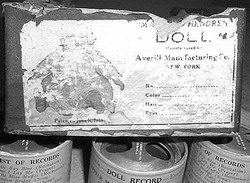
Phonograph dolls talk, sing and play cylinders. The Averill Company marketed Madame Hendren as a phonograph doll in 1918.
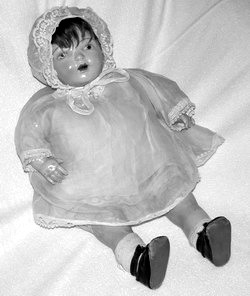
The Original Madame Hendren phonograph doll was made with composition head and limbs and with a cloth body. This 22-inch
doll was painted a soft ivory with painted blue eyes and a human hair wig. She had an open mouth showing two teeth and a
small pink tongue. She was a baby doll that talked by means of the early Arthur motor, which has a small knurled knob to
engage the on/off mechanism. Later models use a lever, rather than a knob, to turn the mechanism on and off.
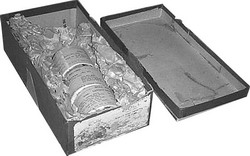
An exciting doll cylinder discovery was made by CAPS member Jean-Paul Agnard. Jean-Paul had purchased some Averill doll
cylinders on e-Bay. When they arrived, he observed that they were in the original shipping box and that the colour of the
cylinders was much darker than the familiar light blue Averill doll cylinders. In fact, the cylinders were black in colour,
each in a pink-coloured cylinder box. Jean Paul then shared this information with us and the search was on for information
concerning these unusual black cylinders.
The Original Madame Hendren Doll came with a box of cylinders. They came in sets of six or eight cylinders. The boxes in
which the cylinders were packed varied in length. One box was 10 inches long, containing five cylinders, and another box
was 12 inches long, containing eight cylinders. The cylinders are black and found in pink-coloured boxes. The early cylinders
had the song name imprinted on a metal plate on one end, and some had a paper label. These cylinders were purchased in a
packing box with the "Madame Hendren" logo pasted on the end of the box and the notation "Patented June 11, 1918."
Later cylinders were a light blue colour and found in a light tan cylinder box. The familiar light blue cylinders are played by many
phonograph dolls such as Madame Hendren, Mae Starr, EffanBEE and Lovums and other dolls that have the Averill motor. The Madame Hendren
Doll was born in 1922, weighed five pounds and was 25 inches tall. The Averill Manufacturing Company made this phonograph doll
and named her Dolly-Rekord. Many phonograph collectors refer to Dolly-Rekord as the Madame Hendren doll.
The Mae Starr doll is another doll that played the light blue cylinders. Mae Starr is 29 inches tall, four inches larger than the
Genuine Madame Hendren. The Mae Starr doll was made from 1928 through 1944, when doll production stopped because of the shortage
of materials due to World War II. On the back of the shoulder plate is the identifying name: "Mae Starr Doll". There
is a rare advertising cylinder for Mae Starr titled "The Mae Star Dolly", which carries this title on the rim of the cylinder.
These cylinders were supplied by the Averill Company.
The doll cylinders sold for thirty-five cents each and are light blue celluloid over a cardboard core. They are 2 3/16 inches in
diameter and 1 1/4 inches in length covered on one end with a metal plate with two round finger holes to facilitate removal of the
cylinder from the mandrel. The cylinders are identified with various markings such as: Averill Manufacturing Co., New York City,
U.S.A.; Universal Talking Toys Co. Newark N.J. U.S.A.; The Mae Starr Dolly (a paper label with the song title and number), while
some labels have no markings whatsoever.
It is believed that the Indestructible Record Company of Albany, New York may have manufactured many of the cylinders, although a
reference also cited the Universal Talking Toys Co. A fire destroyed the Albany plant in October of 1922 and we can only speculate
on which company manufactured the cylinders after this date. We would appreciate any documentation regarding the source of these
cylinders.
Phonograph dolls and toys were made to enchant children. We just published a book on the history of talking toys, from Thomas Edison’s
first talking doll in 1890 to digital talking dolls and toys of the 21st century. This soft cover book covers over eleven decades and
features over 500 colour photographs illustrating talking dolls, children’s records and phonograph toys. Treasured toys from major
collections throughout the world are illustrated in this book. A price guide is included. To the children who played with these wonderful
talking toys, however, they are priceless.
|
|
Wright's Stuff or This Page Intentionally Blank:
Canadian 50 Tracks or Hoser Rock and the Elephant In the Corner
by Keith Wright
It was last summer that The Wrights had fun listening to (and arguing with) CBC radio’s summer filler program called 50 Tracks,
which 'searched' for the most essential pop songs of the 20th century. Keith detailed this in the Nov-Dec 2004 issue of APN. CBC
was at it again this winter but concentrated specifically on Canadian pop songs.
In his article Keith sets the stage, then quotes away and finally lets us in on the essential list. The excruciating tension started
during the first week dealing with the 1970s. What was going to happen to that Snowbird song? Could he stand the suspense? Would he
actually have to hear it? These and other burning questions - that elephant in the corner - are all answered in the article.
The results were as diverse as one could have imagined. The Big Winners were Gordon Lightfoot and Randy Bachman with three songs each.
In the next tier with two songs each were The Tragically Hip, Blue Rodeo, Leonard Cohen and Joni Mitchell. The oldest song was "My
Swiss Moonlight Lullaby" by Wilf Carter (1933). There were two songs from the 21st century: "Crabbuckit" by K-OS (2004) -
a song Keith admits to subsequently purchasing - and "Brother Down" by Sam Roberts (2001). The only song in our other Official
Language was "Mon Pays" by Gilles Vigneault (1965), which was added entirely by popular vote. No song got as much as 5% of the vote.
Celine and Shania were conspicuously absent.
For Keith the program did its job, as he has since downloaded many of the 50 Tracks songs. His thirteen-year-old son is currently
playing the Bryan Adams 1984 hit, "Summer of '69'" to death and he's continually on the search for downloads of Stan Rogers.
Check out the entire list in Keith's article. There is much on it to recommend.
|
|
A "Happy" Discovery
by John E. Rutherford
In 1940, I came to Canada from England as a war guest to escape the bombing of London, and I stayed for the rest of the war.
I lived in Islington and attended Etobicoke High School. One of my youthful joys was to listen to "The Happy Gang"
on the radio. Those were sad days for a lonely "limey", and to hear young cheerful voices singing "The King is
Still in London" and "There'll Always be an England", was a pleasure that would be difficult to duplicate today.
At Christmas time, 1943, I think, the Air Cadet squadron #210 to which I belonged was invited down to the radio studios of the
CBC to attend a performance of "The Happy Gang" show. And there they all were, alive and real. Bert Pearl was their
leader; Blaine Mathe was the violinist, Kathleen Stokes (whose whole family was later drowned in a boating accident) played the
organ, and among the others was the young Torontonian, Eddie Allen, whose light tenor voice was a delight. (His recording of
Malotte’s "Lord's Prayer" is excellent.) He was the youngest of the Gang and he died about two years ago, the last
of the Gang to go.
The Happy Gang made many records for the RCA Victor – "Carry On", "Bugle Call Rag", "Don’t Play Bingo Tonight,
Mother" – and the memory of their contribution in uplifting the spirits of a war-torn country has not been forgotten.
Recently, I met an elderly gentleman who had been a member of the prestigious Press Club. Our conversations turned to recordings
and he mentioned that "The Happy Gang" had visited the Press Club and performed for the members. From a bookshelf he
produced a "Happy Gang" record that each member of the Gang had autographed, and I was asked if I would like to have it.
It did not take me long to decide. In those good old days the only way to autograph a black record label was to use white ink which
often flaked off, as you can see in the illustration. Some of the ink may have gone, but not the memories.
|
|
|
|